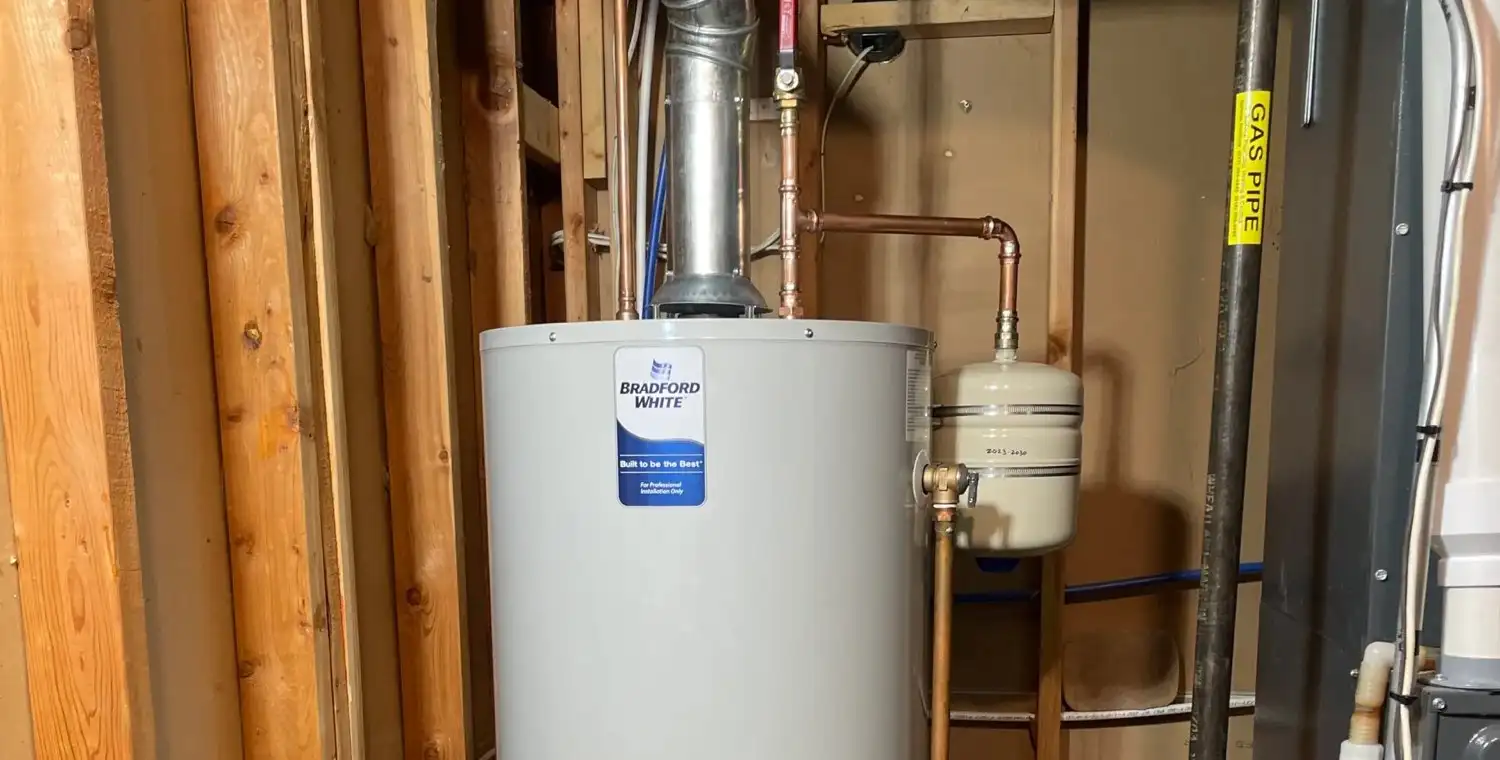
A water heater that is leaking from the base is not repairable. The tank has rusted through, and the only question left is whether you replace it today or after it empties forty gallons onto the floor.
AT A GLANCE
- Typical lifespan
- 8 to 12 years for a tank heater on hard water
- Same-day swap
- Often possible for a like-for-like tank replacement
- Permit required
- Yes, in every jurisdiction we work in. We pull it.
- Typical sizing
- 40 to 50 gallons for a family of four on a tank system
- Code item people miss
- Thermal expansion tank, required on a closed system
Replace it before it fails, or replace it after
There are two ways to buy a water heater. One of them is a scheduled Tuesday morning where somebody comes out, quotes it flat, and swaps it. The other is a Sunday where the tank has already let go, the pan has overflowed, and you are also buying carpet.
Tanks give warning. Rusty water at the hot tap, popping and rumbling during a heating cycle, water at the base of the unit, or simply an age north of ten years. Any of those is a reason to get a number now, while it is still your decision.
Sizing it for the house, not for what was there
The replacement heater is often the same size as the old one for no better reason than that it is the same size as the old one. That is fine if the household has not changed. It is not fine if the house gained two teenagers, lost four people, or added a soaking tub.
We size on first-hour rating against actual peak demand — how much hot water the house needs in its busiest hour, not over a day. That is usually 40 to 50 gallons for a family of four on a conventional tank, but it moves with fixture count and habits.
The parts of the job people do not see
The heater itself is the easy part. The install is where the difference is: a properly routed temperature and pressure discharge line that terminates where a failure would be visible rather than inside a wall, a drain pan actually plumbed to somewhere, correct combustion air and venting, dielectric unions so dissimilar metals do not eat each other at the connections, and the thermal expansion tank.
At altitude, combustion appliances also need attention to derating. Air at six thousand feet is thinner, and gas appliances have to be specified and set up for it. It is on the label and in the code, and it gets skipped constantly.
COMMON QUESTIONS
How long does a water heater last in Colorado?
Eight to twelve years is typical for a tank unit on Front Range water. Hard water shortens it — scale settles on the bottom of the tank, insulates the burner from the water, and drives the steel harder than it was designed for. A softener meaningfully extends heater life, which is why the two jobs often get quoted together.
Should I switch to tankless?
Tankless makes sense if you run out of hot water regularly, you want the floor space back, or you are already opening up the gas and venting for another reason. It is a bigger install — larger gas line, different venting, sometimes an electrical circuit — so the upfront cost is meaningfully higher. If your current tank is adequately sized and you are just replacing an old unit, a tank heater is usually the better value.
Can you replace it today?
For a like-for-like tank replacement, often yes — common sizes are stocked, and it is the kind of job we can usually work into the same day if you call in the morning. A tankless conversion or a change in fuel type needs planning for gas sizing and venting, so that gets scheduled. We are open Monday to Friday, 8am to 5pm.
Do I need a permit to replace a water heater?
Yes, everywhere we work. A water heater involves gas or high-amperage electrical, combustion venting, and pressure relief — which is exactly the list of things permits exist for. We pull it and coordinate the inspection. If a contractor offers to skip the permit to save you money, understand that you are the one who owns the unpermitted work when you sell the house.
What is a thermal expansion tank and do I need one?
Water expands when heated. If your house has a backflow preventer or pressure-reducing valve on the incoming main — which most modern ones do — that expansion has nowhere to go, and the pressure spikes every heating cycle. That kills the T and P valve, the heater, and eventually fixtures. An expansion tank gives it somewhere to go. It is required by code on closed systems and it is the single most commonly omitted item on a cheap water heater install.